
Authoritative Sources
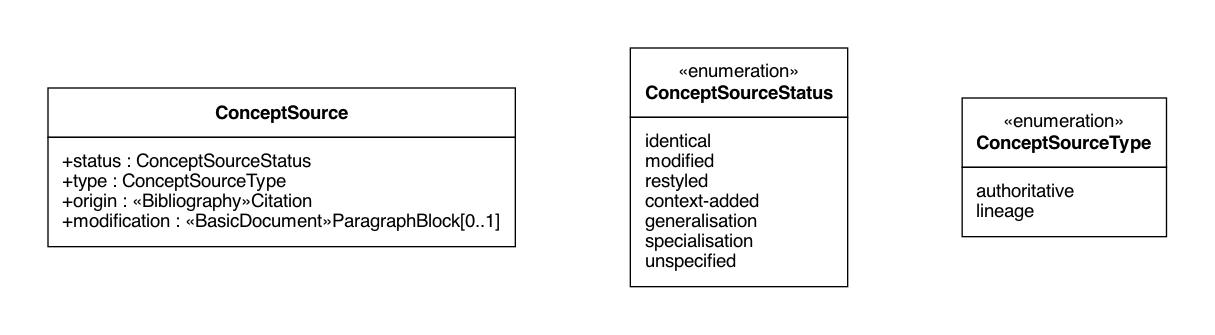
An authoritative source is the "source of truth" for a terminological entry or any of its parts. It is the bibliographic reference from which the content originates, represented in the model by the ConceptSource class. See the ConceptSource entity definition for the authoritative field list.
ConceptSource fields
| Field | Type | Card. | Description |
|---|---|---|---|
type | sourceType | 0..1 | authoritative or lineage |
status | sourceStatus | 0..1 | Relationship between entry content and source |
origin | Citation | 0..1 | The bibliographic citation |
modification | string | 0..1 | Description of changes made relative to the source |
Source type
Each ConceptSource carries a type attribute distinguishing between two kinds of source:
authoritative— The source is the definitive origin of the content.lineage— The source documents the historical derivation or provenance of the content, but is not itself the authoritative reference.
For example, a term may originate from ISO 19101 (authoritative) but also reference an earlier ITU definition from which the ISO definition was derived (lineage).
Source status
The status attribute describes the relationship between the entry content and the cited source:
| Status | Description |
|---|---|
identical | The content is identical to what appears in the source |
modified | The content has been modified from the source |
restyled | The content has been restyled (e.g. formatting changes) |
context-added | Additional context has been added to the source content |
generalisation | The content is a generalisation of the source content |
specialisation | The content is a specialisation of the source content |
unspecified | The relationship to the source is unspecified |
The optional modification attribute can provide a description of any change made relative to the cited source.
Citation
A bibliographic citation with structured reference, locality, and optional link.
| Field | Type | Card. | Description |
|---|---|---|---|
ref | CitationRef | 0..1 | Structured citation reference (source + id + optional version) |
locality | Locality | 0..1 | Location within the cited document |
link | anyURI | 0..1 | URL to the cited document |
original | string | 0..1 | Original text from the source |
custom_locality | CustomLocality[] | 0..* | Custom name-value locality pairs |
Citation Reference
A structured reference to a source document.
| Field | Type | Card. | Description |
|---|---|---|---|
source | string | 0..1 | The source document identifier |
id | string | 0..1 | The specific identifier within the source |
version | string | 0..1 | Version of the source |
Locality
A location within a cited document (section, clause, page, etc.).
| Field | Type | Card. | Description |
|---|---|---|---|
type | string | 1..1 | Locality type (e.g. section, clause, page) |
reference_from | string | 0..1 | Start of the locality range |
reference_to | string | 0..1 | End of the locality range |
Custom Locality
A custom name-value locality pair within a citation.
| Field | Type | Card. | Description |
|---|---|---|---|
name | string | 1..1 | The locality name |
value | string | 1..1 | The locality value |
Multi-level source hierarchy
Sources can be attached at multiple levels of the model:
| Level | Scope |
|---|---|
ManagedConcept.sources | Applicable to the concept as a whole |
LocalizedConcept.sources | Applicable to a specific language version |
Designation.sources | Sources for individual terms |
DetailedDefinition.sources | Sources for individual definitions, notes, or examples |
NonVerbRep.sources | Sources for non-verbal representations |
This hierarchy means that a concept may have multiple authoritative sources. A concept's definition may come from one standard while a specific term for that concept comes from another.
The glossary as authoritative source
In some cases, the glossary itself is the authoritative source — when a term and its definition originate within the glossary rather than being adopted from an external standard.
See the YAML Schema Reference for the complete JSON Schema definitions, the Entity Field Reference for all entity types, and the Standards compliance reference for ISO standard mappings.